Majesty
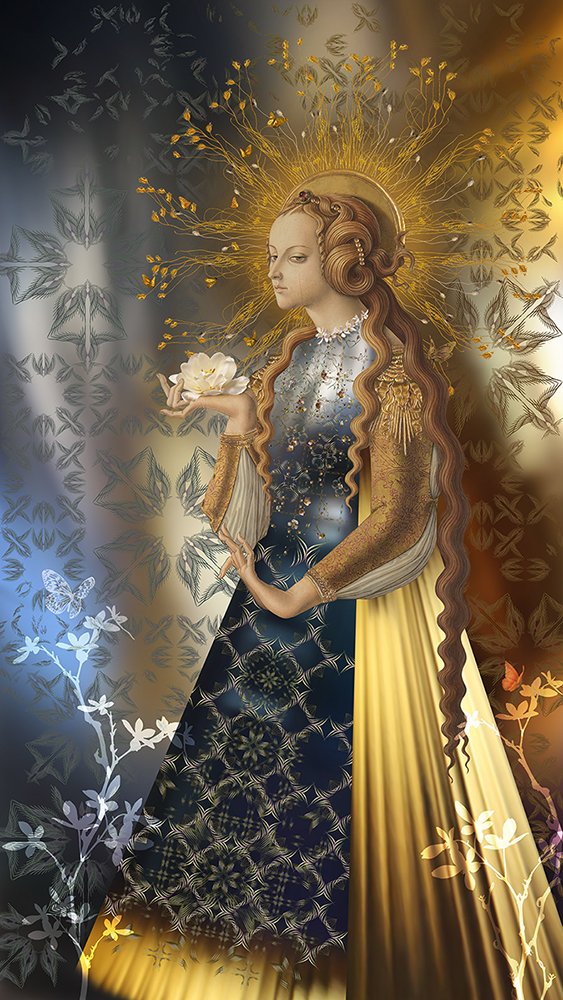
Our latest work is called Majesty. This piece emerged from our fascination with portraits from the Middle Ages and the early Renaissance. In medieval painting, systematic knowledge of perspective was still lacking. As a result, interiors and clothing were often depicted flatly but richly filled with patterns. The texture of the fabric, or the way it draped over the shoulders, was of secondary importance. The detailing lay in the pattern itself.
Only in the early Renaissance did perspective begin to make its entrance, yet the legacy of medieval ornamentation remained palpable. Filled with gold and motifs that demanded as much attention as the portrait itself, an iconic figure often emerged: a paragon of power and wealth.
MAJESTY
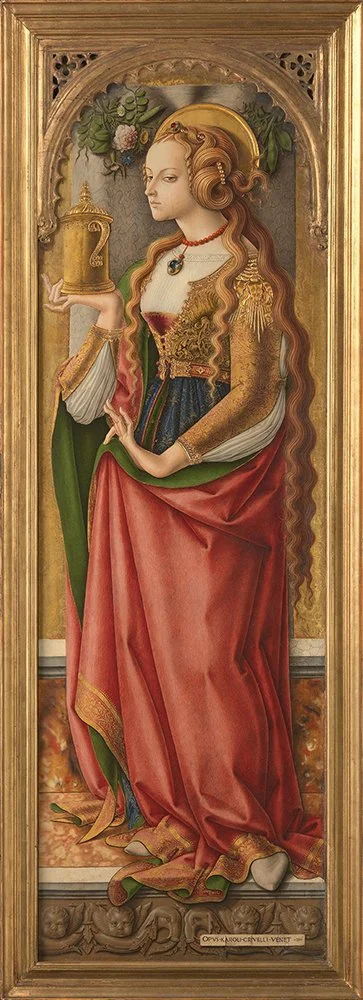
The same goes for Carlo Crivelli’s Mary Magdalene, a masterpiece of the early Renaissance that forms the foundation of Majesty. Crivelli managed to weave perspective and realism together with spiritual meaning.
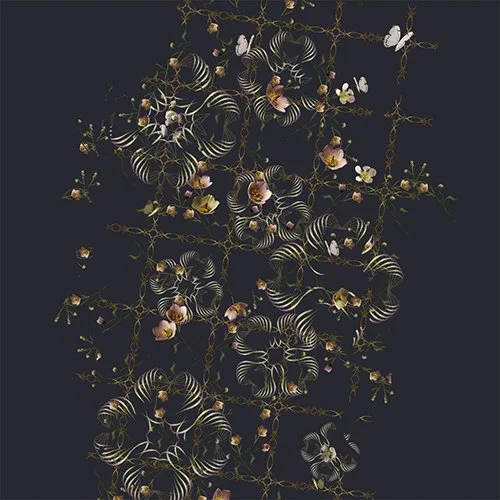
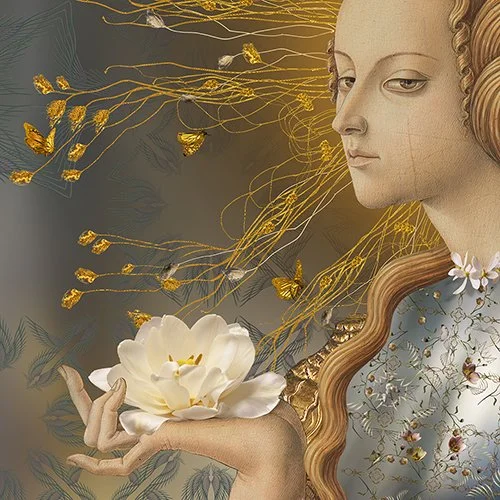
He often used natural motifs, such as flowers and butterflies, to depict themes like transience and transformation, or rather, growth and change. We have translated this work from an imagination rooted in the narrative of the Christian faith into a stately, rich, and powerful image. It conveys a sense of order, monumentality, and harmony. In both technique and approach, Majesty aligns meticulously and artisanally with our earlier works, such as The Earth Laughs in Flower, Bang Bang, and Cinderella. Here too, an image was constructed from hundreds of carefully photographed flowers and twigs.
Craftmanship
At Chinnoe & Vlemmix, every work begins with something small. A flower, a leaf, a tiny branch. With care and attention, we capture each of these in our own photography. In this way, we build a library of natural forms: flowers, branches, grains, leaves, and even butterflies.
Then the craft begins. Every element is woven into graceful, rhythmic patterns reminiscent of medieval manuscripts and centuries-old decorative motifs. No algorithm, no mass production, just pure patience, an eye for detail, and a love for the material. This is how a work emerges that not only celebrates nature but also the timeless rhythm of making itself.

Carlo Crivelli’s
Maria Magdalena
The Rijksmuseum in Amsterdam owns a painting by Carlo Crivelli, titled Mary Magdalene and dated around 1480. Since 2012, the museum has made thousands of high-resolution artworks freely available through Rijksstudio.
With this platform, the Rijksmuseum aims to inspire creators worldwide not only to admire art but also to actively use it and transform it into new creations. By connecting art from the past with today’s creative practices, the collection gains new life within contemporary contexts and generations.
This work, executed in tempera on panel, depicts Mary Magdalene in a richly detailed and symbolic representation characteristic of Crivelli’s style. The painting was likely created as an altarpiece for a rural church dedicated to Mary Magdalene in the Marche region of Italy, where Crivelli was active at the time.